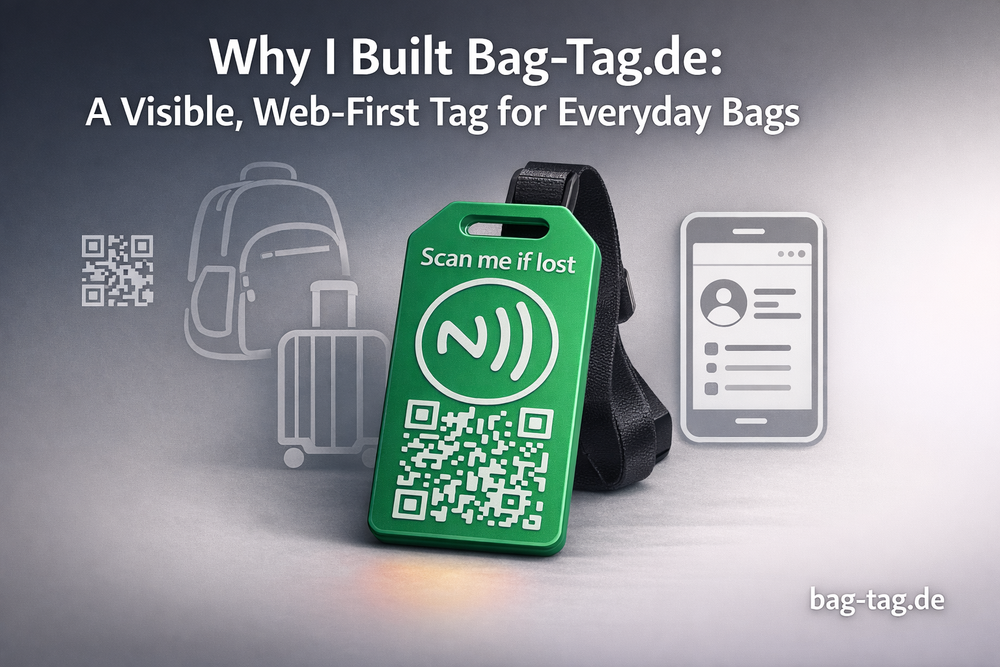
Why I Built Bag-Tag.de: A Visible, Web-First Tag for Everyday Bags
Sometimes the best ideas start with something small and annoying.
In my case it was luggage.
Suitcases and backpacks all look the same once they’re on a conveyor belt or stacked in a hallway. The usual paper tags tear off, cheap plastic ones break, and even if they survive, nobody actually reads the tiny text unless something goes wrong.
I wanted something different:
- a tag that is visibly mine (not just a discreet little label),
- a way for someone to contact me if they find my bag,
- a way for me to manage multiple tags without being locked into one ecosystem,
- and a solution that isn’t restricted to the Apple universe.
That’s how Bag-Tag.de started.
In this post I want to tell the story behind it, show how it works from the user’s perspective, and share a few thoughts about where it fits compared to things like AirTags.
Why I didn’t just buy another AirTag
AirTags are great for what they are: tiny location beacons that piggyback on the Apple device network. But they come with a few constraints:
- they live fully inside the Apple ecosystem,
- they are invisible unless you know they’re there,
- and they solve a different problem: “where is this thing?” – not “who does this belong to and how do I contact them?”.
I was looking for something else:
- a tag that is obviously visible and stands out on a bag,
- a simple contact flow if someone finds it (scan, see info, get in touch),
- a small web-based backend where I can manage multiple tags under one account,
- and the freedom to use it regardless of whether I or the finder are on iOS, Android or something else.
So instead of trying to bend AirTags into something they’re not, I decided to build a system that’s deliberately simple, visible and web-first.
What a Bag-Tag actually is
A Bag-Tag consists of two pieces:
- a physical tag that you attach to your bag (with a bold, high-contrast design so it stands out),
- a small online profile that lives behind a QR code or short URL.
The idea is:
- you customise the tag once (design, colours, maybe a name or icon),
- you attach it to your luggage, backpack, instrument case, kids’ bags – whatever you want,
- if someone finds your bag, they scan the code or open the URL and see exactly the information you chose to share,
- you can update that information later without reprinting the physical tag.
This is what a tag page looks like right now (simplified):
- a clear heading with the tag ID or name,
- some key information about the item (optional),
- contact options (for example an email form or other contact channel),
- and whatever extra hints you want to show (e.g. “this belongs to a child”, “medical equipment”, etc.).
From the outside it’s “just” a QR + website combo. Under the hood there’s a bit more structure.
Managing multiple tags with one account
One of the design goals was: this should scale beyond a single suitcase.
So Bag-Tag.de lets you create an account and manage multiple tags from one place:
- you can register several tags (for different bags, family members, use cases),
- give each tag its own label and contact info,
- and see which tags are active.
Internally, each tag has a unique ID and is connected to your account. The public URL (like the example you’ve seen) only shows what’s necessary to help the finder reach you – nothing more.
This separation is important: if you lose a bag, you want people to reach you easily. But you probably don’t want to dump all your personal details directly on a piece of plastic that can be photographed and posted anywhere.
Why the tags are deliberately not subtle
I didn’t want Bag-Tags to be “just another discreet accessory”. I wanted them to be visually loud enough that:
- you can spot your bag quickly on a conveyor belt,
- other people notice there is a tag they can interact with,
- and it feels more like a statement than a hidden technical gadget.
That’s why the designs on the homepage look bold and colourful rather than minimal and grey. In a sea of anonymous black suitcases, a tag that pops is a feature, not a bug.
From a very practical perspective it means:
- you see your stuff faster,
- you reduce the chance that someone grabs your bag by mistake,
- and if something gets lost, the person who finds it has a clear visual signal: “scan me, there’s more info here”.
How this compares to AirTags and friends
This is not meant to compete with AirTags – it’s solving a complementary problem.
AirTag / similar:
- “I don’t know where my bag is right now; show me its approximate location on a map.”
- Works via Apple’s network of devices.
- Great for tracking something that may be far away or stolen.
Bag-Tag.de:
- “This bag is physically here, someone has it in front of them; how do they know who I am and how to reach me?”
- Works for anyone with a camera and a browser.
- Great for everyday mistakes: wrong bag taken, bag left behind, kids’ bags, shared spaces.
I actually see them as complementary tools:
- if you’re deep in the Apple ecosystem and you want geolocation, an AirTag makes sense,
- if you want a clear, platform-independent way for people to identify and contact you about your bag, a Bag-Tag is a simple, low-tech layer on top.
And if you really care, you can use both. The tag doesn’t care whether there’s an AirTag hiding inside the suitcase as well.
Implementation thoughts (for the tech-curious)
This blog isn’t a full technical deep dive into Bag-Tag.de, but a few pieces might be interesting if you’re a developer:
- Each tag is essentially a record in a database with a unique ID and a set of fields (owner reference, display name, contact options, status).
- The public-facing URL resolves that ID, loads the minimal data needed and renders a simple, mobile-friendly page.
- The owner side is an authenticated dashboard where you can:
- see all your tags,
- edit what’s shown on each tag page,
- deactivate tags if they’re lost or no longer needed.
The interesting part for me was less the tech stack (it’s fairly standard web tech) and more the balance between:
- giving finders enough information to help you,
- and giving you enough control so you don’t overshare by default.
Where I want to take it next
Right now, Bag-Tag.de is deliberately simple. That’s a feature, not a limitation.
Possible future ideas I’m thinking about:
- optional notifications when someone visits a tag page,
- temporary messages on a tag (“I’m travelling, please use email instead of phone”),
- different profiles for different contexts (work, personal, kids),
- integration with simple automations (e.g. logging when a tag was scanned).
But even in its current form, it already does the thing I wanted from the beginning:
- my bags are easier to spot,
- people have a clear way to reach me if something goes missing,
- and I’m not locked into a single vendor ecosystem.
If that sounds useful to you, you can see a live example here:
- Bag-Tag.de – homepage with tag designs
- Example tag view – how a tag looks when someone scans it
And if you end up creating your own tags, I’d be curious to see where they end up in the world.